How to Create Quotations Faster: A Practical Guide for Indian Sales Teams
A customer asks for a quotation.
It sounds like a simple sales task.
But what happens next in many businesses?
The salesperson notes the requirement. If they're in the field, they may WhatsApp or call someone at the office. Someone finds the customer details, selects the products, enters quantities and prices, checks discounts, applies GST, prepares the quotation, converts it to PDF, and sends it back.
For one quotation, this may not feel like a major problem.
But when your team creates 10, 20 or 30+ quotations a day, the same repetitive work happens again and again.
The problem isn't creating a PDF.
The problem is everything your sales team has to do before that PDF is ready.
Why Does Quotation Creation Take So Much Time?
Think about what a salesperson actually needs to do to prepare a quotation.
They may need to:
Find or enter the customer
Find the right products
Enter quantities
Check prices
Apply a discount
Calculate applicable taxes
Add specifications or terms
Check the quotation
Generate the final document
Share it with the customer
Most of these steps aren't selling.
They're administrative steps surrounding the sale.
And the problem becomes more visible when your salespeople are visiting customers.
Imagine a salesperson sitting with a customer who says:
“Send me a quotation for 25 pieces with a 5% discount.”
The salesperson already knows what the customer wants.
But knowing the requirement and having a ready-to-share quotation are still two different things.
That's the gap businesses need to reduce.
The Real Goal Isn't Just Faster Data Entry
A common way to improve quotation speed is to make forms shorter.
That helps, but it doesn't solve the whole problem.
The better question is:
How much information does the salesperson actually need to enter manually?
For many trading and manufacturing companies, business is repetitive.
The same customers buy again.
The same products are quoted again.
Prices, GST details, company information and quotation formats already exist somewhere in the business.
Your quotation system should reuse that information instead of asking the salesperson to recreate it every time.
Start With Your Existing Customer and Product Data
If your company already has hundreds or thousands of customers and products, don't expect the sales team to create those records again while preparing quotations.
Import your existing data first.
That may include:
Customers
Company name
Contact person
Mobile number
Email
Billing information
GST details
Products
Product name
SKU or code
Price
HSN information
Tax details
Specifications
Once this information is available, creating a quotation becomes much simpler.
Instead of entering everything, the salesperson mostly needs to tell the system:
who the customer is, what they need, how much they need and any deal-specific changes.
That is a much smaller job.
What If the Salesperson Could Simply Say What They Need?
This is where AI can change the quotation workflow.
Instead of navigating through several fields, imagine the salesperson saying:
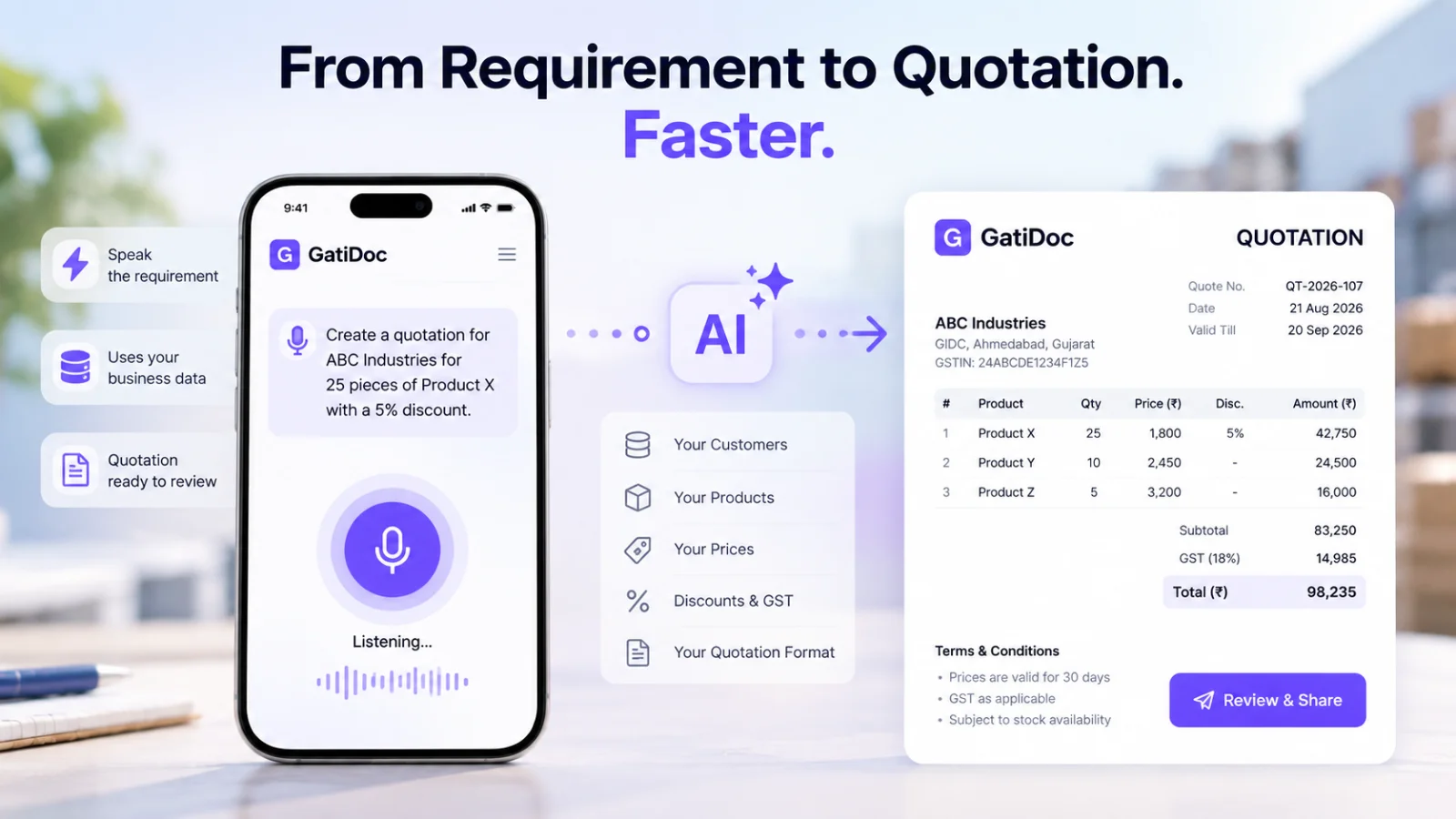
“Create a quotation for ABC Industries for Product X, 25 pieces, with a 5% discount.”
The system already knows the customer.
It already knows the product.
It can use the business's existing information to prepare the quotation structure.
The salesperson then reviews it before sharing.
The workflow becomes:
Speak → Capture → Prepare → Review → Share
The salesperson remains in control, but the repetitive work between the customer's requirement and the finished quotation is reduced.
Voice-to-Quotation Is Especially Useful for Field Sales
Voice isn't valuable simply because speaking is fashionable or because AI is involved.
It's useful because of where salespeople work.
A salesperson may be:
At a customer's factory
At a dealer's office
Travelling between meetings
Standing at an exhibition
On a shop floor
Away from their laptop
Typing a complete quotation from a phone in these situations isn't ideal.
Speaking the requirement is much more natural.
The salesperson can capture what the customer asked for while the conversation is still fresh, review the prepared quotation and continue the sales process without waiting to return to the office.
Don't Remove the Review Step
Faster shouldn't mean uncontrolled.
AI can help prepare the quotation, but your salesperson should still review important details before sending it.
For example:
Customer
Products
Quantity
Price
Discount
GST
Specifications
Terms
Validity
This is especially important for B2B quotations where a small pricing, specification or tax mistake can create a much larger problem later.
The objective isn't:
AI sends quotations without your salesperson.
The objective is:
AI handles repetitive preparation so your salesperson can review and move faster.
A Fast Quotation Isn't Enough If Nobody Follows It Up
Quotation speed solves only the first part of the problem.
Once the quotation is sent, another question appears:
Who remembers to follow it up?
This is where many sales workflows break.
A salesperson sends several quotations today. Tomorrow there are new inquiries, calls, customer visits and another batch of quotations.
Some older quotations naturally disappear from attention.
That's why quotation creation and follow-up shouldn't be treated as completely separate activities.
The sales process should continue after the quotation is shared.
The system should help identify when a quotation needs attention, bring it back to the salesperson, and remove it from the immediate queue once the salesperson has handled it.
When it needs attention again, it should return.
The salesperson shouldn't have to maintain the entire follow-up calendar in their head.
Faster Quotations Should Lead to More Customer Time
The purpose of quotation automation isn't to make salespeople spend more time using software.
It's the opposite.
Your salesperson's time should go toward:
Talking to customers
Understanding requirements
Visiting prospects
Negotiating
Following opportunities
Building relationships
Closing business
Software should handle as much repetitive execution around those activities as practical.
That's the principle behind GatiDoc.
How GatiDoc Approaches Quotation Creation
GatiDoc is being built for quotation-heavy sales teams in businesses such as trading, manufacturing, distribution and engineering.
With Voice Intelligence, a salesperson can describe the quotation they need in natural language.
For example:
“Create a quotation for ABC Industries for Product X, 25 pieces, with a 5% discount.”
GatiDoc turns that requirement into structured quotation information using the business's available customer and product data.
The salesperson reviews the result before sharing it.
And quotation creation isn't isolated from the rest of the sales process.
GatiDoc connects it with the other parts of sales execution, including follow-up prioritisation, business insights, asking questions about business information, and contextual assistance during negotiation.
The idea is simple:
Your salesperson handles the customer. GatiDoc helps handle the repetitive work around the deal.
Is Faster Quotation Creation Right for Every Business?
Not necessarily.
If your company creates one or two simple quotations occasionally, changing your process may not make much difference.
The opportunity becomes more meaningful when:
Your team creates quotations every day
You have multiple salespeople
Salespeople work in the field
Customers and products repeat
Your team creates 10+ quotations per day
Quotations require products, quantities, discounts, GST or specifications
Salespeople depend on office staff to prepare quotations
Follow-ups are sometimes forgotten after quotations are sent
The more quotation-heavy the sales process becomes, the more valuable it is to remove repetitive steps.
Start by Measuring Your Current Process
Before buying any software, do one simple exercise.
Take your next five quotations and measure:
How long does it take from the moment the customer gives the requirement until the quotation is ready to share?
Don't measure only the typing time.
Include the waiting.
Include the calls between salesperson and office.
Include searching for information.
Include corrections.
Include the time the salesperson spends entering information that your business already knows.
That will show you where the real quotation bottleneck is.
Because the goal isn't merely to create a quotation faster.
The goal is to get your salesperson back to selling faster.